
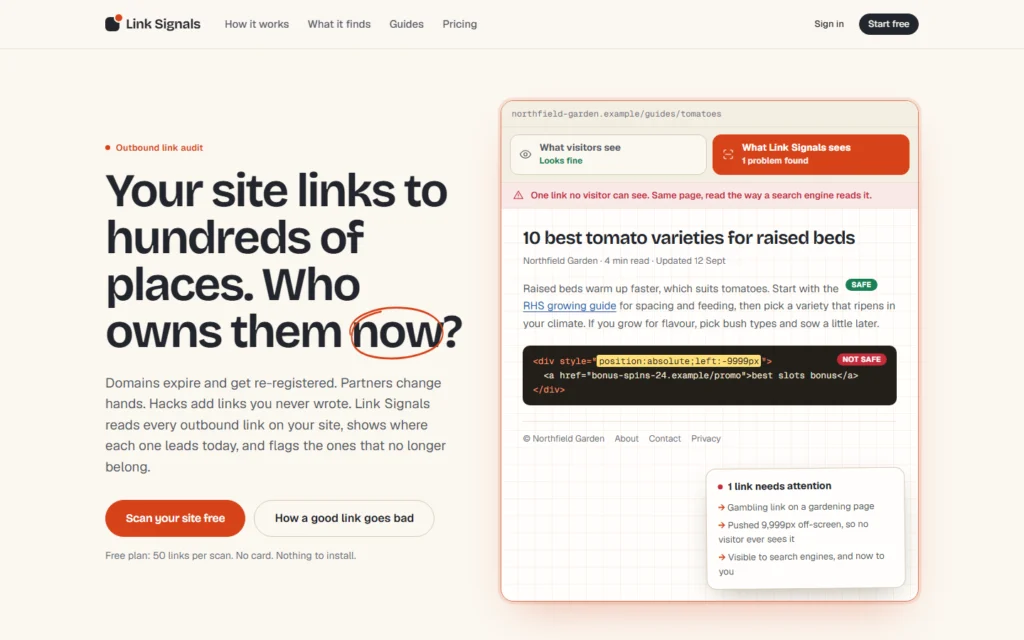
A site that has been publishing for a few years collects outbound links nobody has looked at since the day they went live: citations in old articles, partner links, resource lists, directory entries. Each one points at a domain that somebody has to keep paying for. When they stop paying, the name returns to the pool, and anyone can register it. Nothing on your side changes. Your page still says the same thing, and the link still sits in the same sentence.
How a good link goes bad
The pattern is simple and common. A business closes, a project is abandoned, or a renewal is missed. The domain lapses. Someone registers it, often because the old name still has inbound links, traffic and a history. What they put there is rarely what your visitors expected: a parked page full of ads, a thin affiliate site, or content that has nothing to do with the original topic. A hacked site is a related case, where a legitimate domain is still registered but unauthorised content has been added to it.
The result for you is a page that recommends a source and sends the reader somewhere else entirely. The wrong destination is worst on the pages that matter most for trust: guides, comparison pages, anything that cites a source to back up a claim.
Why it matters for SEO
Google’s spam policies describe expired domain abuse as the case where an expired domain name is purchased and repurposed primarily to manipulate search rankings
. That policy is aimed at the people who buy and repurpose the domain, and it does not say that a site linking to one is penalised. The practical costs for the linking site are different and still real:
- Relevance and trust. A page that cites a source and delivers an unrelated or low-quality destination reads as careless, to people and to quality systems.
- Your own link signals. Links you publish are signals you vouch for. A link to a domain whose content has changed completely is a link you no longer have a reason to give.
- User experience. Readers who land on gambling, adult or pharmaceutical content from a page about something else do not come back.
Google also gives site owners a way to express the relationship. For links you can no longer vouch for, its guidance on qualifying outbound links describes the nofollow value for cases where you would rather Google not associate your site with
the linked page. Replacing the link with a current source, or removing it, is usually better still.
Why “unregistered” is harder to prove than it looks
The obvious way to find lapsed domains is to ask a registry whether a name is registered, using WHOIS or its modern replacement, RDAP. It is a reasonable first step and a poor last one, because an empty answer does not mean what it appears to mean.
- Registries only know the names they manage. Some UK second-level zones, such as ac.uk and nhs.uk, are not covered by the general .uk registry’s records. In early testing of link checks, live university websites were flagged as unregistered for exactly this reason. They were registered and working; the registry we asked simply held no record of them.
- Dates can be placeholders. Some registries put the Unix zero date, 1 January 1970, into a record. It turns up in reports as a domain “registered in 1970”, and anything that reasons from domain age or expiry then goes wrong.
- A blocked check looks like a dead one. A site that refuses automated visitors can look gone to a checker while working perfectly for people.
The lesson for anyone auditing links, by hand or with a tool, is to treat an absence of data as unknown rather than gone. A single signal should not be enough to call a domain abandoned. Look for a second, independent signal, and then look at the page.
What it looks like in practice
The destinations that cause trouble fall into a few recognisable groups. Sorting links into these groups makes a review faster, because each group gets the same treatment.
- Parked and for-sale pages. The domain resolves and serves a placeholder or a “this domain is for sale” page, often with ads. Nothing alarming appears, but the link is worthless as a citation.
- Repurposed domains. The name now hosts unrelated content, frequently a thin affiliate or lead-generation site. These are the closest match to the pattern Google describes.
- Taken-over brands. A company was acquired, merged or renamed. The old domain redirects or hosts something about the new owner, which may or may not still support what you cited.
- Hacked sites. The domain is still registered and still belongs to the right organisation, but unauthorised links or pages have been added to it.
- Quietly abandoned sites. Still registered and online, no longer maintained. They do not need to be removed, but they are weak sources for a page that wants to be authoritative.
Only one of these groups shows up as an error in a conventional broken-link report. The rest return a normal page, which is why they survive audits that only look for 404s.
A routine that works
- Group by destination, not by page. A few hundred distinct domains can account for thousands of links, which makes the review manageable.
- Start with the oldest pages. That is where abandoned destinations accumulate.
- Look at what is there now. Does the destination still match the topic? Is it parked, for sale, in a different language, or wrapped in ads?
- Decide per link: keep it, replace it with a current source, remove it, or qualify it with the right
relvalue. - Record the decision and the date, so the next review starts from what you already know.
This is the problem we built Link Signals to look for across a whole sitemap. The same review can be done by hand on a small site, and the principle holds either way: a link audit that only finds 404s misses the destinations that still load and no longer belong.
Replace, remove or qualify?
Replace is almost always the best answer. Find the current authoritative source for the claim and link to that, so the page keeps its citation and the reader gets what they were promised. Remove the link when the claim no longer needs a source or no good source exists, and keep the sentence if it is still true. Qualify only where a link has to stay for a reason other than endorsement. Google’s guidance describes sponsored for paid placements, ugc for user-generated content such as comments and forum posts, and nofollow for cases where neither fits. Qualifying a link is not a substitute for dealing with one that no longer belongs on the page.
Questions that come up
Does linking to a repurposed domain hurt my rankings?
Google’s spam policy describes the behaviour of the people who buy and repurpose expired domains. It does not say that sites linking to them are penalised. The risks to you are relevance, trust and the experience of the reader, and those are reason enough to fix the link.
Should I disavow these domains?
No, that is a different problem. Google’s disavow tool is for links that point to your site. Outbound links are controlled by you, so the fix is on your own pages.
How often should I check?
More often than once. Domains lapse at any time, and a one-off audit goes stale. Check your most important pages more frequently than the archive.