
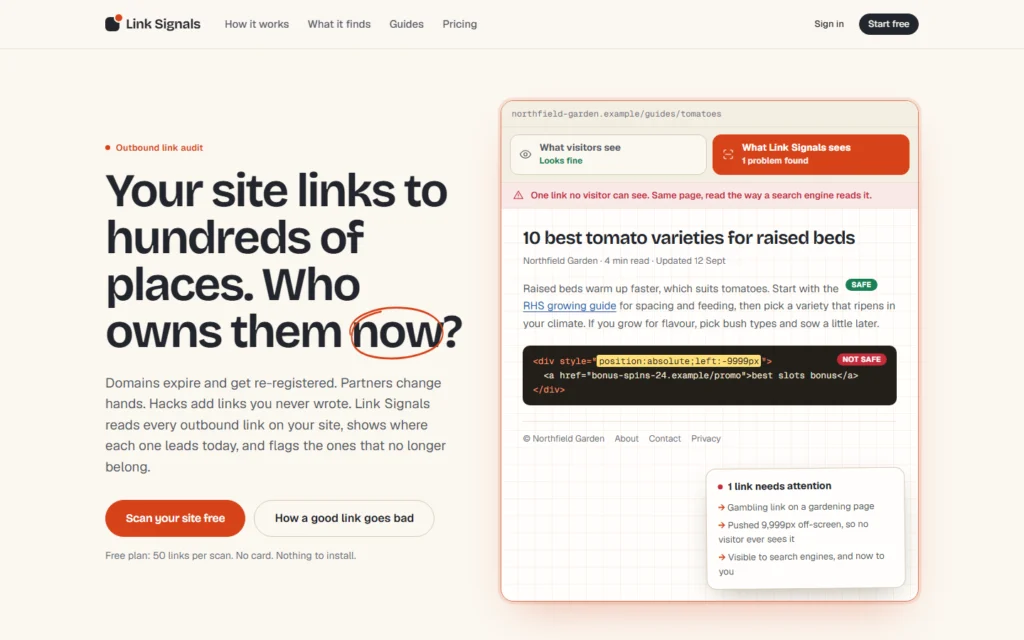
Most outbound-link audits are done once, usually after a migration or when a new SEO takes over a site. They produce a spreadsheet, a round of fixes and a sense that the job is finished. The trouble is that the thing being audited keeps moving. Nobody has to edit a page for its links to become a problem.
The web does not stay put
Pew Research Center looked at how often online content disappears and reported that 38% of webpages that existed in 2013 are no longer accessible a decade later
. Outbound links point at that moving target. Pages are removed and sites are restructured, and as covered in the previous article on expired domains, whole domains lapse and are re-registered by someone else.
Links can also change because your own site changes. Google defines hacked content as any content placed on a site without permission
, and its examples include hidden links injected into pages. A compromised page is an outbound-link problem that appears with no edit from you.
What an audit cannot tell you
An audit tells you the state of your links on the day you looked. It cannot tell you which ones will change next, and most of the damage comes from changes that happen after it. A link that was fine in March can point at an unrelated site by June, and the first person to notice is often a reader or a competitor.
There is a second weakness. Audits tend to produce a long list that is acted on once and then forgotten. The links people decide to leave alone, because they are borderline or because nobody has time, are the ones most likely to matter later, and nothing prompts anyone to look at them again.
What monitoring adds
Monitoring turns the audit into a routine with three useful properties:
- It watches the destinations, not only your pages, because that is where the change happens.
- It reports changes rather than totals. A weekly note that one link on a high-value page now points somewhere different is actionable. A repeated list of everything flagged is noise.
- It lets decisions expire. If you choose to leave a flagged link in place, that decision was based on how things looked at the time. When the same link later gets worse, it should come back to your attention instead of staying ignored.
The right frequency depends on the page. Your home page, top landing pages and anything that cites sources for a claim deserve more attention than a ten-year-old archive. Link Signals supports weekly and daily monitoring for that reason.
How the drift happens: an illustration
Take a hypothetical guide published in 2019 that cites a small supplier’s study to support a claim, and links to it. In the first year nothing happens. In the second year the supplier is bought and its website is folded into the parent company’s, so the study’s address starts redirecting to the new home page. The link still “works”, in that it returns a page, and no audit that only looks for errors will flag it. In the fourth year the redirect is removed and the old address returns a 404, which is the first point at which a conventional broken-link report would notice. Had the supplier’s domain instead been allowed to lapse and been re-registered, the link would have started to deliver something unrelated, with no error at any point.
The same link was fine, then misleading, then broken, over several years, and the page was never edited. A single audit would have caught it in exactly one of those states, and only if it was run in the right year.
What to record about each decision
A decision you cannot find again has to be made again. For every flagged link you choose to keep, replace or ignore, a short record is enough:
- the page and the destination;
- what you saw on the day (parked page, unrelated content, redirect to a home page);
- what you decided, and why;
- the date, and what would make you look again.
Deciding what to watch most closely
Not every page deserves the same attention, and trying to treat them equally leads to either an overwhelming list or no routine at all. A useful order is:
- Anything in a template. A link in a footer, sidebar, author box or navigation appears on every page. One bad destination there is a site-wide problem.
- Pages that earn traffic or links. These are the pages whose credibility matters most.
- Pages that cite sources for claims, such as guides, statistics roundups and comparison pages.
- The archive. It matters least per page, but it is where abandoned destinations pile up, so it needs a slower, steady sweep.
Signal, not noise
Monitoring that reports everything every week is soon ignored. The reports worth acting on say what changed since last time, put the most serious change first, and stay quiet when nothing has happened. A flagged link that you decided to accept should be listed separately from new findings, so that it neither inflates the count nor disappears.
Accurate sitemap dates help everyone
Whatever does the checking, whether a search engine or your own tooling, has to decide what to look at again. The lastmod date in an XML sitemap is the usual signal for that. Google says it uses the value only if it’s consistently and verifiably
accurate, and it describes a significant update as a change to the main content, the structured data or the links on the page. A sitemap whose dates change on every build teaches crawlers to ignore them; one that only changes when content or links change keeps the signal useful.
What to do
- Treat the first audit as a baseline, not a finish line.
- Decide how often your important pages should be re-checked, and by what.
- Keep sitemap
lastmoddates honest. - When you decide to leave a flagged link alone, write down why, and what would change your mind.
A practical cadence
- Immediately after a migration, a redesign, or a security incident.
- Weekly or daily for your highest-value pages and anything in a template.
- Monthly for the rest of the live site.
- Quarterly for the archive, using a sample if the site is very large.