SEO Strategy · Guide

Measure whether the work did what it was meant to.

A strategy is only useful if you can tell whether it is working. Measurement has to be designed before the changes ship, reported in terms the business cares about, and revisited as results and the search environment change.

Talk to an SEO specialist More on SEO Strategy

Measurement design

Measurement design is deciding, before the work starts, what will be measured, from which source, over what period, and what result would count as success or failure. Without it, results are interpreted afterwards to fit whatever happened.

Google's Performance report is the main first-party source for organic search. It reports clicks, impressions, click-through rate and average position, grouped by query, page, country, device, search appearance and date, and can be filtered by search type such as web, image, video or news. Its time granularity matters for design: weekly and monthly views smooth out fluctuations such as weekends or holidays, while daily views help detect issues or spikes. Google also notes that the newest data can be preliminary and may change.

The traffic-drop guidance adds two design points. Look at 16 months of data and compare against similar periods, so seasonal patterns are not mistaken for effects. And if you want to keep data for longer, use the Search Analytics API or bulk data export to pull data into your own systems. Google's page on bulk data export describes a daily export of performance data to BigQuery, covering all the performance data available for the property except anonymized queries.

Timing needs agreeing too. The SEO Starter Guide says some changes take effect in hours and others take several months, and suggests waiting a few weeks to assess whether work had a beneficial effect. A measurement plan states the baseline, the comparison period and the review date for each change, and records what else changed at the time, such as a site move or a Google update.
Source: Google Search Central: Performance report (Search results): Overview and basic setup

Reporting that answers business questions

A report is useful when it answers a question someone is going to act on: is organic search growing in the areas that matter, did the last release help or harm, where is the next gain? A table of every metric available answers none of them.

Search Console data can answer several of these when read carefully. The traffic-drop guidance shows how the pattern in the Performance chart points to different causes. If both impressions and clicks fall, it points you to a list of common causes. If impressions stay the same but clicks fall, the page title and snippet may not be doing their job, or other sites may have a more appealing rich result. Reading the two together is a better answer than reporting either alone.

Reporting should also be honest about what the data cannot say. The Performance report notes that chart and table totals can differ because of how data is aggregated, and that values shown as unavailable are zeros in an export. Google keeps a page of data anomalies in Search Console, which the traffic-drop guidance recommends checking before assuming a real change. Our Insights articles on unavailable data in SEO reporting and on what clients should see in SEO reporting develop both points.

Our Ongoing SEO page states the principle: SEO involves inference, and clients deserve to see which is which, so a report separates what is known from what is not.

A reporting set-up designed around business questions also makes it easier to revise the strategy. If the numbers do not move as expected, the report should help show whether the reason lies in the plan, the delivery or the environment.

Source: Google Search Central: Debug Google Search Traffic Drops

Ongoing strategic consultancy

A strategy written once becomes out of date. Sites change, competitors move and Google updates how it assesses content. Google's traffic-drop guidance says it is always improving how it assesses content and that core updates and smaller updates may change how some pages perform; it also says that a drop after an update does not necessarily mean anything is fundamentally wrong with the content.

Ongoing strategic consultancy is the continuing role of someone who can read the results, say what they mean and adjust the plan. It is not a promise of outcomes. The SEO Starter Guide says that if you are not satisfied with results and your business allows it, you can iterate with changes and see whether they make a difference. That is the loop in practice: change, measure, then decide again.

This is not the same as running an SEO programme day to day, and the difference is worth stating. In our terms, consultancy is expertise added to your team, while ongoing SEO is us running the programme. Many clients move between the two. The strategic part is the same in both: reviewing the evidence, challenging the priorities and deciding what comes next.

The practical forms vary from scheduled reviews to ad hoc questions on decisions such as migrations, architecture and priorities. See the consultancy and ongoing SEO pages for how each works.

Source: Google Search Central: SEO Starter Guide: The Basics

What Cultured Digital covers: Measure

Measurement design, reporting that answers business questions, and ongoing strategic consultancy are the "Measure" group in the scope of our SEO Strategy work, and the fifth step in how we work: check whether the work produced the intended result. After that comes iterate, because SEO is not a one-off checklist and the loop continues.

We do not promise rankings or traffic numbers. We set out the opportunity and the evidence, and measure against it. What is known and what is not should both be visible in the reporting. Where the work continues, it is run as ongoing SEO or as consultancy.

Built by us

Tools built by Cultured Digital: Measure

SEO Ops, our WordPress plugin for SEO client work, has stated features that relate to reporting.

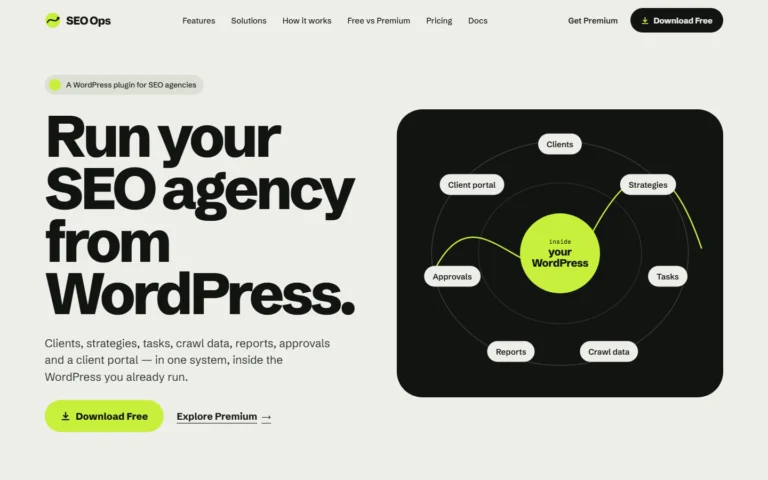
Screenshot of the SEO Ops website: "Run your SEO agency from WordPress", with a diagram of clients, strategies, tasks, reports, crawl data, approvals and client portal inside WordPress. Tool · Live SEO Ops A WordPress plugin that keeps SEO clients, strategies, tasks, crawl data, reports, approvals and a client portal in one system. Built with: WordPress plugin (WordPress 6.5+, PHP 8.1+), runs on your own WordPress install View tool →

SEO Ops includes reporting, and its Premium plan adds Google, Semrush and Ahrefs connections.

Questions

Measure: questions answered.

How long should we wait before judging an SEO change?

Google says some changes take effect in a few hours and others take several months, and suggests waiting a few weeks before assessing whether work had a beneficial effect.

Why look at 16 months of Search Console data?

Google's traffic-drop guidance recommends it so a drop can be seen in context and checked against yearly patterns such as a festivity or trend.

Will you promise ranking or traffic targets?

No. We do not promise rankings or traffic numbers. We set out the opportunity and the evidence, and measure against it.

What is the difference between consultancy and ongoing SEO?

Consultancy is expertise added to your team. Ongoing SEO is Cultured Digital running the programme. Many clients move between the two.

Not sure whether the work is working?

Tell us what has been done and what you are seeing. We'll say what can be established, what cannot, and what to measure next.

Talk to an SEO specialist