SEO Strategy · Guide

Fix the foundations in an order a team can deliver.

Strategy only works on a site that can be crawled, rendered and understood. Fixing the foundations means turning technical findings into a plan that accounts for who has to build each change, what it depends on and what could go wrong.

Talk to an SEO specialist More on SEO Strategy

Technical roadmaps

A technical roadmap is an ordered list of the technical changes a site needs, each with the evidence behind it. It is different from an audit export, which lists what a tool found. A roadmap says what to change, why, and in what order.

Google's guide to maintaining a site's SEO begins with a warning that applies to any roadmap: if you do not understand the crawl, index and serving pipeline, it will be difficult to debug issues or anticipate how Search behaves on your site. The same guide lists the areas a technical plan usually touches. They include duplicate content and canonical pages, making sure resources and pages Google is meant to crawl are not blocked, using robots.txt to prevent crawling (and not to prevent indexing), using sitemaps to help Google discover and prioritise pages, handling multilingual sites, and migrating pages or whole sites.

Evidence for roadmap items comes partly from Google's own reports. The Page indexing report, the Crawl Stats report and the URL Inspection tool show what Google has found, how it crawls the site and what it knows about a particular URL. Google's traffic-drop guidance recommends the Crawl Stats and Page indexing reports to find out whether a drop matches a spike in detected issues.

The detail of each technical area is on the Technical SEO page and its topic pages, such as crawling and indexing. A strategy roadmap draws on that work and places it alongside content and architecture decisions. Findings are only useful to a roadmap once they are tied to a cause: a tool reports symptoms, and the work is finding which step of discovery, crawling, rendering, indexing or understanding is failing.
Source: Google Search Central: Technical SEO Techniques and Strategies

Dependencies on development

Most technical SEO changes are made by developers, in code, templates or server configuration, and they compete with other work for the same capacity. A dependency is anything that has to happen before a change can ship or before its effect can be seen. Google has no documentation on managing these; this section is general explanation, supported by what our own pages state.

Hypothetical example: a roadmap line recommends that duplicate product URLs point to a preferred version. The change needs a template release. It may also need the sitemap to list only the preferred URLs, and a redirect rule agreed with the team that owns the server. If the roadmap names only the first of these, the work stalls when the other two are discovered.

Google's description of canonicalisation shows why the combination matters. In its canonical guidance it says that redirects, rel="canonical" annotations and sitemap inclusion are signals of different strength, and that these methods can stack and become more effective when combined. A good roadmap therefore treats related changes as one piece of work, not as separate tickets that might ship months apart.

Dependencies also include the practical conditions for each change: who must approve it, which release it travels in, and what to check before and after. Our implementation and QA page covers developer collaboration and testing, and our Insights article on SEO changes that need sign-off before launch looks at the approval side.

Naming dependencies is also what lets a plan be challenged honestly. If a line depends on a rebuild that is a year away, the roadmap should say so, and say what can be done in the meantime.

Source: Google Search Central: How to specify a canonical with rel="canonical" and other methods

Risks and sequencing

Every technical change carries some risk, and the order in which changes ship affects both the risk and how clearly the results can be read. Sequencing means deciding what goes first, what must wait for something else, and what is separated so its effect can be seen.

Google's traffic-drop guidance shows the kinds of risk. Technical issues can be site-wide, such as a site that is down, or page-wide, such as a misplaced noindex tag; because the latter depends on Google recrawling, the drop can be slower. Changing the URLs of existing pages can cause ranking fluctuations while Google recrawls and reindexes, and the guidance says a medium-sized site can take a few weeks for Google to notice the change, with larger sites taking longer. It also recommends avoiding radical changes if a page is already performing well.

Google's guidance on site moves and migrations and on redirects covers the highest-risk change: altering URLs. Our migrations page covers the planning, testing and monitoring for it.

On timing, the SEO Starter Guide says changes can take effect in a few hours or several months, and suggests waiting a few weeks before judging whether work had a beneficial effect. That argues for sequencing changes so they can be told apart, and for agreeing in advance how each will be checked. Our Insights article on WordPress launch checks that protect rankings is a practical companion for releases.

Source: Google Search Central: Debug Google Search Traffic Drops

What Cultured Digital covers: Fix the foundations

Technical roadmaps, dependencies on development, and risks and sequencing are the "Fix the foundations" group in the scope of our SEO Strategy work. Our strategy sits on top of Technical SEO, because strategy depends on a site that can be crawled and understood.

Every line of our roadmap says what to do, what evidence supports it and what it depends on. We work alongside your developers or implement where required: a recommendation that nobody implements has achieved nothing. Releases can be checked before and after launch, so regressions are caught early.

Built by us

Tools built by Cultured Digital: Fix the foundations

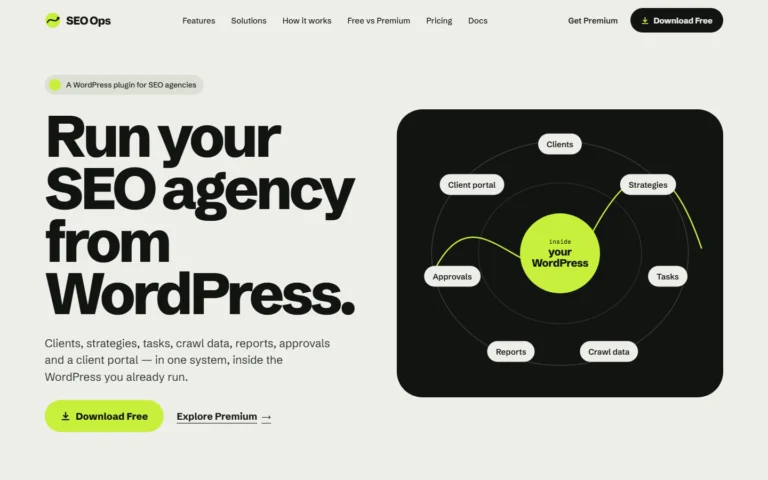
SEO Ops, our WordPress plugin for SEO client work, has two stated features that relate to this stage.

Screenshot of the SEO Ops website: "Run your SEO agency from WordPress", with a diagram of clients, strategies, tasks, reports, crawl data, approvals and client portal inside WordPress. Tool · Live SEO Ops A WordPress plugin that keeps SEO clients, strategies, tasks, crawl data, reports, approvals and a client portal in one system. Built with: WordPress plugin (WordPress 6.5+, PHP 8.1+), runs on your own WordPress install View tool →

SEO Ops imports Screaming Frog data for technical findings and turns recommendations into tasks.

Questions

Fix the foundations: questions answered.

What is the difference between an audit and a technical roadmap?

An audit finds the problems. A roadmap orders the fixes, with the evidence for each and what each depends on. In our work, every roadmap line says what to do, what evidence supports it and what it depends on.

Can robots.txt keep a page out of the index?

Google's guidance says to use robots.txt rules to prevent crawling, and not as a mechanism to prevent indexing; for that, use the noindex tag or login requirements.

How long before technical fixes show in search?

Google says some changes take effect in a few hours and others several months, and suggests waiting a few weeks before assessing whether work had a beneficial effect.

What if our developers have no capacity?

We can hand a prioritised roadmap to your developers, work alongside them, or build and implement the changes ourselves.

Findings sitting in a backlog?

Tell us what has been recommended, what is blocking it and what the platform is. We'll say how we would get it moving.

Talk to an SEO specialist